研究
Topic guide — what do these subjects study?
These browsing tags overlap: a paper can belong to several topics. Counts show this bibliography, not the number of papers in the whole field. A topic with zero papers still has a learning explanation; it does not imply a publication here. Use the topic filter with year, author role and search. “Mass spectrometry” is the usual term for measuring masses; optical spectroscopy measures spectra. Topic explanations: English.
Existing research themes
N = Z nuclei / MASSPASS (4)
Precision masses near equal neutron and proton numbers probe shell evolution and astrophysical reaction paths.
Typical observables: See the linked research programme and papers.
Show papers (4)Q values for neutrino physics (11)
Decay-energy measurements assess candidates for direct neutrino-mass experiments.
Typical observables: See the linked research programme and papers.
Show papers (11)Atomic masses and isotope shifts (1)
Accurate atomic masses support isotope-shift analysis and the separation of mass and nuclear-size effects.
Typical observables: See the linked research programme and papers.
Show papers (1)Storage rings, MR-TOF and MCP detectors (7)
Ion manipulation, precision timing and position detection enable rare-isotope mass measurements.
Typical observables: See the linked research programme and papers.
Show papers (7)Mass methods and beams
Mass spectrometry and ion-beam applications (71)
Measures and separates ions by mass-to-charge ratio. Precision masses and clean isotope beams support decay-energy, nuclear-structure and astrophysics studies.
Typical observables: Atomic masses, Q values, beam purity and emittance.
Show papers (71)Mass-spectrometry innovations in heavy-ion research (27)
Develops Penning traps, MR-TOF instruments, storage rings, timing detectors and ion optics for rare isotopes. Read resolving power, accuracy and efficiency separately: a narrow peak alone does not establish an accurate mass.
Typical observables: Resolving power, calibration, timing, transmission and systematic uncertainty.
Show papers (27)Laser spectroscopy and ion sources (4)
Laser spectroscopy uses isotope shifts and hyperfine structure to determine radii, spins and moments. Ion sources create and prepare the required beam; a laser-ablation source is not automatically a laser-spectroscopy measurement.
Typical observables: Isotope shifts, hyperfine constants, charge radii, beam yield and purity.
Show papers (4)Nuclear structure
Shape coexistence and nuclear structure (0)
Different intrinsic nuclear shapes can produce low-lying states in the same nucleus. Energies, electromagnetic transitions and radii help distinguish coexistence from a gradual change in deformation; a mass trend alone is not proof.
Typical observables: Low-lying 0+ states, E0/E2 strengths, charge radii and configuration mixing.
Show papers (0)Nuclear structure and isotope evolution (25)
Follows how shell structure, pairing and deformation change along isotope or isotone chains. Here isotope evolution means changes with proton or neutron number, rather than motion of isotopes through a material.
Typical observables: Separation energies, shell gaps, pairing indicators, radii and isomers.
FRIB nuclear theory · IGISOL research programme ·
Show papers (25)Multi-neutron systems (4)
Investigates correlations and possible resonances in systems made only of neutrons. A short-lived resonance-like structure must be distinguished from a bound nucleus and from final-state interaction effects.
Typical observables: Missing-mass spectra, relative energies, widths and reaction-model dependence.
Observation of a correlated free four-neutron system ·
Show papers (4)Dipole resonances and strength distributions (1)
Examines dipole excitations and how their strength is distributed in energy. Electric dipole motion can reveal collective response and weakly bound neutron dynamics; a low-energy peak requires interpretation before being called a distinct resonance.
Typical observables: E1 strength, excitation energy, decay channels and polarizability.
Show papers (1)Octupole deformation and correlations (1)
Reflection-asymmetric, often pear-like shapes involve octupole degrees of freedom. Static deformation and octupole vibrations are different possibilities, tested through spectra, parity partners and electric-octupole transition strengths.
Typical observables: Parity doublets, E3 strengths, collective bands and deformation indicators.
Octupole collective motion review ·
Show papers (1)Nuclear structure and isospin symmetry (3)
Compares mirror nuclei and isobaric multiplets by exchanging proton and neutron roles. Coulomb effects and other charge-dependent interactions break ideal isospin symmetry, affecting displacement energies and precision weak-decay tests.
Typical observables: Multiplet masses, Coulomb displacement energies, IMME coefficients and decay corrections.
FRIB fundamental symmetries · FRIB nuclear theory ·
Show papers (3)Neutron skins and nuclear symmetry energy (0)
The neutron skin is the difference between neutron and proton root-mean-square radii. Its relation to the density dependence of symmetry energy is model-dependent; charge radii alone do not directly measure a neutron skin.
Typical observables: Neutron/proton radii, parity-violating scattering, dipole polarizability and equation-of-state constraints.
Show papers (0)Decay and symmetries
Beta decay and fundamental symmetries (2)
Uses decay rates, spectra and angular correlations to test the weak interaction. Searches for time-reversal violation or non-standard couplings need controlled nuclear and detector effects; an ordinary beta-decay measurement is not itself evidence of symmetry violation.
Typical observables: Correlation coefficients, Vud, spectral shapes and systematic corrections.
Show papers (2)Neutrino masses and double beta decay (13)
Direct beta or electron-capture endpoints probe the neutrino mass scale through decay kinematics. Double-beta studies also need Q values and nuclear matrix elements; neutrinoless decay, if observed, would test lepton-number conservation. These methods make different assumptions.
Typical observables: Q values, endpoint spectra, phase-space factors, matrix elements and backgrounds.
DOE: neutrinoless double beta decay ·
Show papers (13)Nuclear structure and isotope decay (29)
Uses radioactive decay to identify levels, spins, transition strengths and long-lived isomers. Decay energies and branching ratios connect the mass surface to the structure of parent and daughter nuclei.
Typical observables: Half-lives, Q values, branching ratios, level schemes and beta strength.
IGISOL research programme · FRIB fundamental symmetries ·
Show papers (29)Nuclear astrophysics
Nucleosynthesis and the chemical evolution of stars (7)
Links nuclear reaction and decay networks to the abundance of elements in stars and ejecta. Masses and lifetimes constrain pathways, while stellar evolution and mixing determine how products reach later generations of stars.
Typical observables: Abundances, reaction flows, masses, half-lives and astrophysical conditions.
Show papers (7)Nuclear reactions and nucleosynthesis in novae (0)
Classical novae are thermonuclear outbursts on accreting white dwarfs. Resonances, proton captures and beta decays determine reaction rates and the isotopes ejected; a supernova or Big-Bang study is not automatically a nova study.
Typical observables: Resonance energies and strengths, temperature-dependent rates and ejecta yields.
JINA: nuclear astrophysics · IGISOL research programme ·
Show papers (0)Astrophysical reactions and nuclear dynamics (8)
Connects laboratory cross sections and resonances with reaction rates in astrophysical plasmas. Reaction mechanisms, target states and uncertainties matter when translating a beam experiment into a stellar rate.
Typical observables: Cross sections, resonance strengths, reaction rates and network sensitivity.
Show papers (8)Heavy nuclei and reactions
Superheavy-element synthesis and decay (0)
Creates the heaviest nuclei in fusion reactions and identifies them through decay chains. Production probabilities compete with fission, and shell effects influence survival. Transfer reactions on heavy targets do not automatically imply superheavy-element synthesis.
Typical observables: Evaporation-residue cross sections, alpha-decay chains and fission lifetimes.
GSI superheavy-nucleus research ·
Show papers (0)Fission-fragment dynamics and energy distributions (2)
Studies how a fissioning nucleus divides mass, charge, energy and angular momentum between fragments. Fragment yields and isomer populations constrain the roles of shell structure, excitation and the scission process.
Typical observables: Mass/charge yields, total kinetic energy, spin distributions and isomeric ratios.
GSI: shell effects in fission ·
Show papers (2)Detector technologies
Superconducting calorimeters for precision detection (0)
Measures deposited energy as a tiny temperature rise at cryogenic temperatures. Transition-edge sensors use the steep resistance change near a superconducting transition; energy resolution, response time and background must be assessed together.
Typical observables: Energy resolution, thermal response, pile-up, calibration and noise.
Show papers (0)Resistive plate chambers in particle detection (0)
Gas detectors with resistive electrodes amplify ionization signals in a strong electric field. They provide fast timing and triggering in particle experiments; they are a different technology from MCP detectors.
Typical observables: Efficiency, time resolution, rate capability, gas mixture and ageing.
CMS resistive plate chambers ·
Show papers (0)高精度のイオントラップおよび蓄積リング質量分析により、ニュートリノ物理、原子核構造、原子核天体物理の問題に取り組んでいます。各テーマの論文は共通の論文データベースから表示され、全リストは 論文 ページにあります。
図で見る実験手法 #
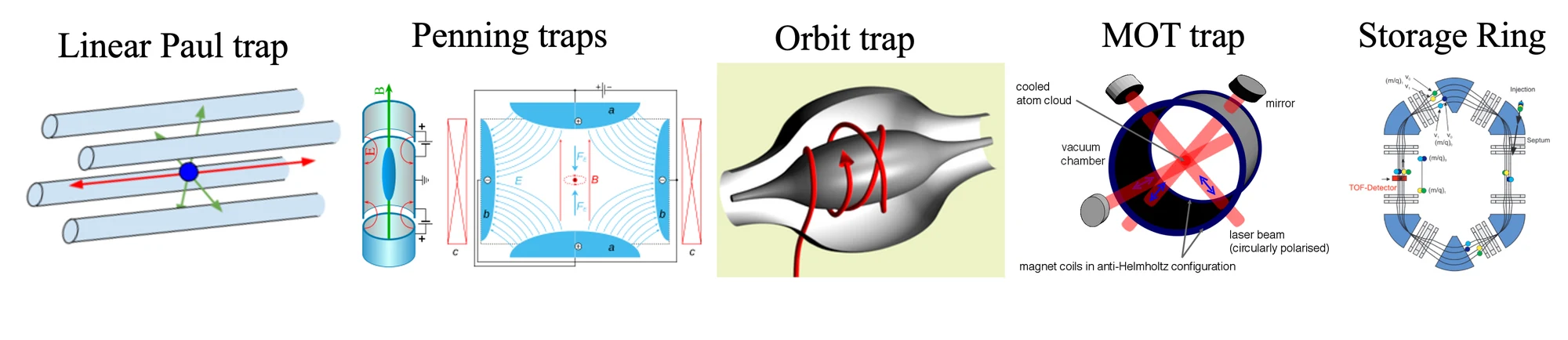

イオントラップと原子トラップの仲間たち——しくみ
アニメーションによる模式図(縮尺は不正確)。赤/青 = 電極の極性(RF 装置では RF とともに反転);色付きの軌跡は1個のイオンまたは原子。
¹⁰⁰Sn までの N = Z エキゾチック核 — MASSPASS #
アカデミー研究員プロジェクト(代表)。IGISOL(ユヴァスキュラ)と RIKEN(日本)で ¹⁰⁰Sn までの N = Z エキゾチック核とその近傍核の質量を測定し、最も重い自己共役二重魔法数核へ向かう殻構造の変化と rp 過程の核物理入力を調べています。プロジェクトページ
4 件の文献記録
- , Direct mass measurement of ⁹¹Rh and ⁸⁹Ru and mid-shell trend of the one-proton separation energies for N = Z + 1 nuclei, Phys. Rev. C 114, 034311 (2026)
- , Direct mass measurement of ⁹³Pd and implications for the isomer structures in ⁹⁴Ag, Phys. Rev. Research 7, L042022 (2025)
- , High-precision mass measurements of neutron-deficient silver isotopes probe the robustness of the N = 50 shell closure, Phys. Rev. Lett. 133, 132503 (2024) · arXiv:2401.07976
- , Study of mass-measurement method for N = Z nuclei with isochronous mass spectrometry, Nucl. Phys. Rev. 36, 294 (2019)
ニュートリノ質量決定のための Q 値 #
ペニングトラップで崩壊エネルギー(Q 値)を直接測定し、将来のニュートリノ質量直接測定実験に向けた超低 Q 値の β⁻ 崩壊・電子捕獲遷移を探索し、適さない候補を除外します。
11 件の文献記録
- , Precise determination of electron-capture Q value of ¹¹³Sn decay related to electron neutrino mass measurements, Phys. Rev. C 114, 035501 (2026) · arXiv:2604.03410 — QEC = 1039.25(19) keV
- , High-precision direct decay energy measurements of the electron-capture decay of ⁹⁷Tc, Phys. Rev. C 112, 035501 (2025) · arXiv:2502.04490 — QEC = 324.82(21) keV
- , High-precision measurements of the atomic mass and electron-capture decay Q value of ⁹⁵Tc, Phys. Lett. B 859, 139094 (2024) · arXiv:2406.05273
- , Direct high-precision measurement of the mass difference of ⁷⁷As–⁷⁷Se related to neutrino mass determination, Eur. Phys. J. A 60, 104 (2024) · arXiv:2401.15242
- , β⁻ decay Q-value measurement of ¹³⁶Cs and its implications for neutrino studies, Phys. Rev. C 108, 045502 (2023) · arXiv:2306.04604
- , Direct determination of the atomic mass difference of the pairs ⁷⁶As–⁷⁶Se and ¹⁵⁵Tb–¹⁵⁵Gd rules out ⁷⁶As and ¹⁵⁵Tb as possible candidates for electron (anti)neutrino mass measurements, Phys. Rev. C 106, 015502 (2022) · arXiv:2202.07656
- , High-precision electron-capture Q value measurement of ¹¹¹In for electron-neutrino mass determination, Phys. Lett. B 832, 137226 (2022) · arXiv:2201.12573
- , Observation of an ultralow-Q-value electron-capture channel decaying to ⁷⁵As via a high-precision mass measurement, Phys. Rev. C 106, 015501 (2022) · arXiv:2203.00457
- , High-precision measurement of a low Q value for allowed β⁻ decay of ¹³¹I related to neutrino mass determination, Phys. Lett. B 830, 137135 (2022)
- , ¹⁵⁹Dy electron-capture: a new candidate for neutrino mass determination, Phys. Rev. Lett. 127, 272301 (2021) · arXiv:2106.06626
- , Direct measurement of the mass difference of ⁷²As–⁷²Ge rules out ⁷²As as a promising β-decay candidate to determine the neutrino mass, Phys. Rev. C 103, 065502 (2021) · arXiv:2103.08729
同位体シフト研究のための原子質量 #
1 件の文献記録
- , High-precision measurement of the atomic mass of ⁸⁴Sr and implications to isotope shift studies, Eur. Phys. J. A 60, 147 (2024) · arXiv:2404.02025
蓄積リング・MR-TOF・MCP 検出器 #
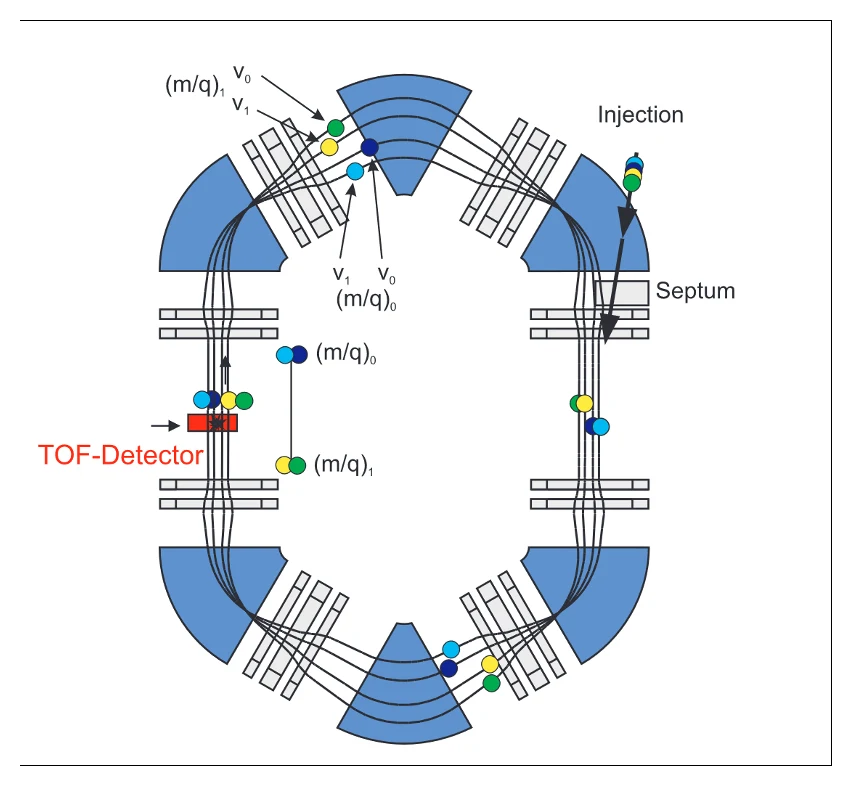
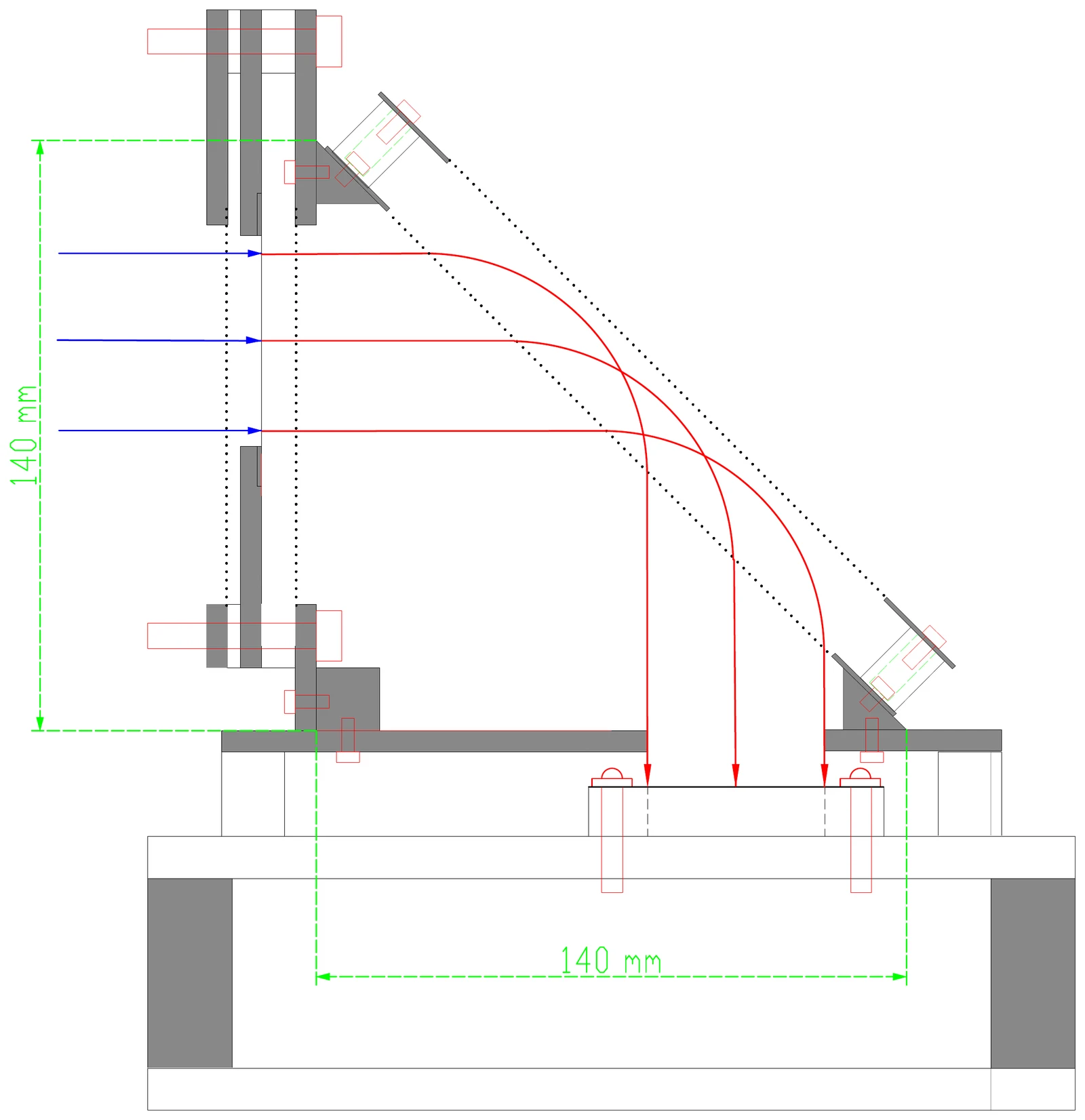
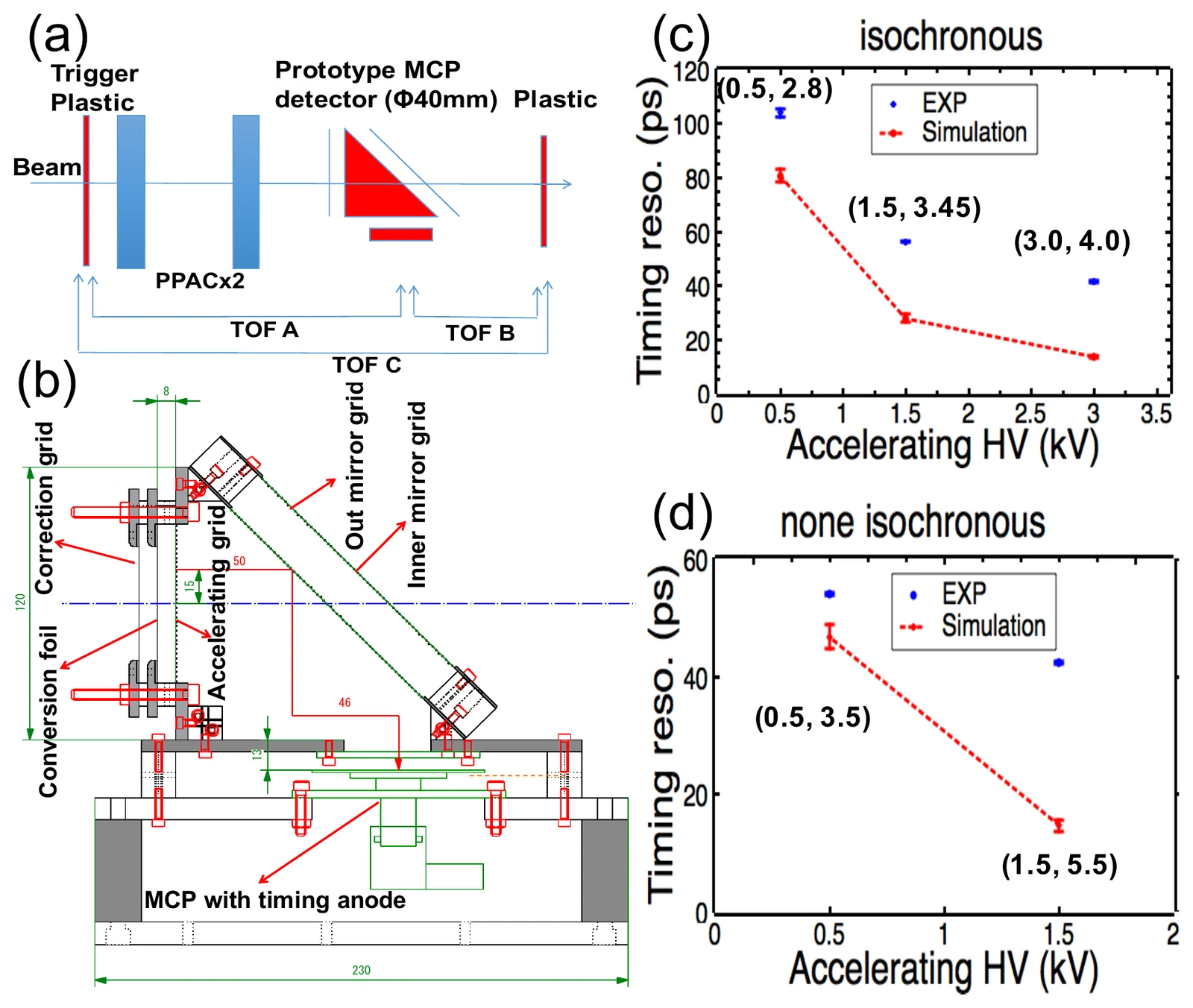
博士課程では RIKEN の稀少 RI リング(Rare-RI Ring)で等時性質量測定のための二次イオン識別と、時間・位置検出型マイクロチャンネルプレート(MCP)検出器の開発を行いました。その後、IGISOL と GSI FRS Ion Catcher の MR-TOF 分光器、HIAF 向け検出器構想へと展開しています。
7 件の文献記録
- , High-resolution multi-reflection time-of-flight mass spectrometer for exotic nuclei at IGISOL, Nucl. Instrum. Methods A 1088, 171513 (2026)
- , Overview of high-performance timing and position-sensitive MCP detectors utilizing secondary electron emission for mass measurements of exotic nuclei at nuclear physics facilities, Sensors 24, 7261 (2024) — review
- , Development of a large-area timing and position-sensitive foil-MCP detector for mass measurements at the Rare-RI Ring in RIKEN, arXiv preprint (2021) · arXiv:2106.08264
- , Development of mirror-type MCP detectors for mass measurements at the Rare-RI Ring, JPS Conf. Proc. 35, 011023 (2021)
- , Scheme of high-resolution identification and selection of secondary ions for mass measurements with the Rare-RI Ring, Hyperfine Interact. 240, 92 (2019)
- , Electrostatic-lenses position-sensitive TOF MCP detector for beam diagnostics and new scheme for mass measurements at HIAF, Nucl. Sci. Tech. 30, 152 (2019) · arXiv:2105.14551
- , Timing performance of a mirror-type MCP detector for mass measurements at the Rare RI Ring, RIKEN Accel. Prog. Rep. 51, 152 (2018)
イオン光学設計 #
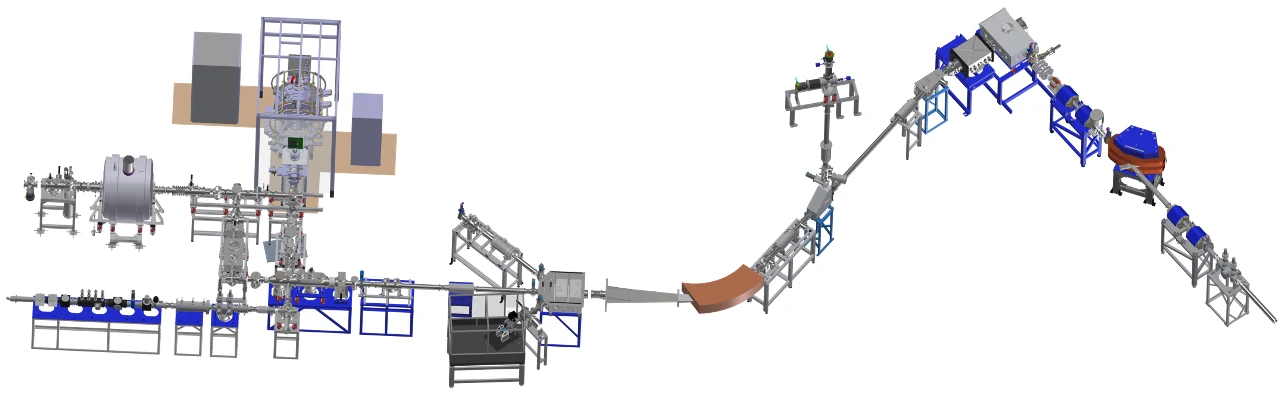
ビームライン、蓄積リング、トラップ装置のイオン光学設計:理研 Rare-RI Ring の入射イオン光学、等時性質量測定のシミュレーション研究、そして現在は SIMION を用いた RFQ・MR-TOF・ペニングトラップのビームライン設計。
- Z. Ge, Q. Wang, M. Wang, T. Uesaka, Study of mass-measurement method for N = Z nuclei with isochronous mass spectrometry, Nucl. Phys. Rev. 36, 294 (2019)
- Z. Ge et al., Online results for the injection ion optics of the Rare RI Ring, RIKEN Accel. Prog. Rep. 49, 180 (2016)
原子核物理 #
- 安定線から離れた殻進化と魔法数——¹⁰⁰Sn に向かう N = Z 核
- アイソスピン対称性、鏡像核とクーロンエネルギー差
- 精密質量から得る分離エネルギー、対相関、アイソマー
- ニュートリノ物理のための稀崩壊の Q 値
原子核宇宙物理 #
- N = Z 近傍の rp・νp 過程の待機点核の質量
- r 過程ネットワーク計算のための中性子過剰核の質量
- X 線バーストと元素の起源のための原子核物理インプット
科学的背景 #
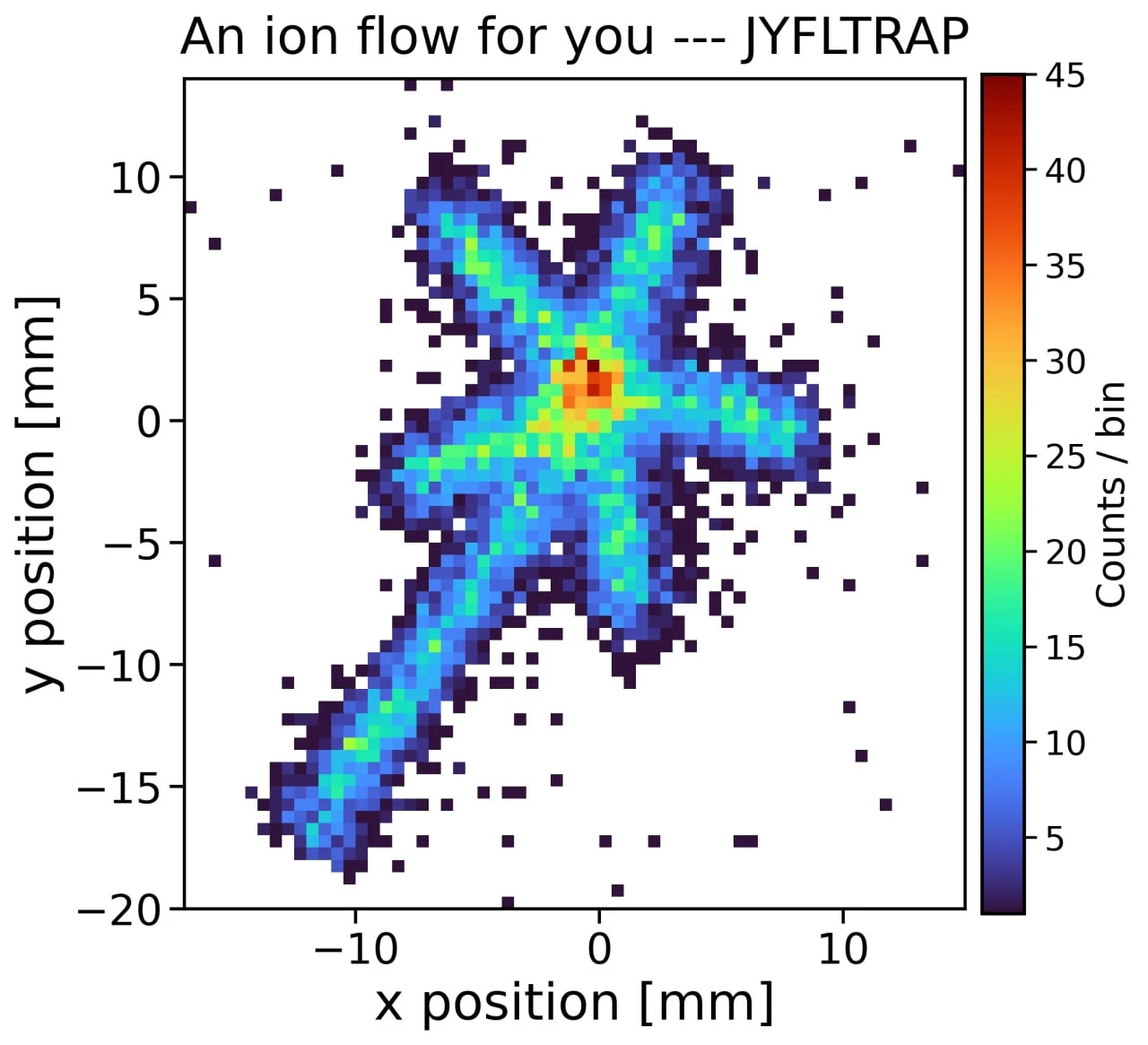
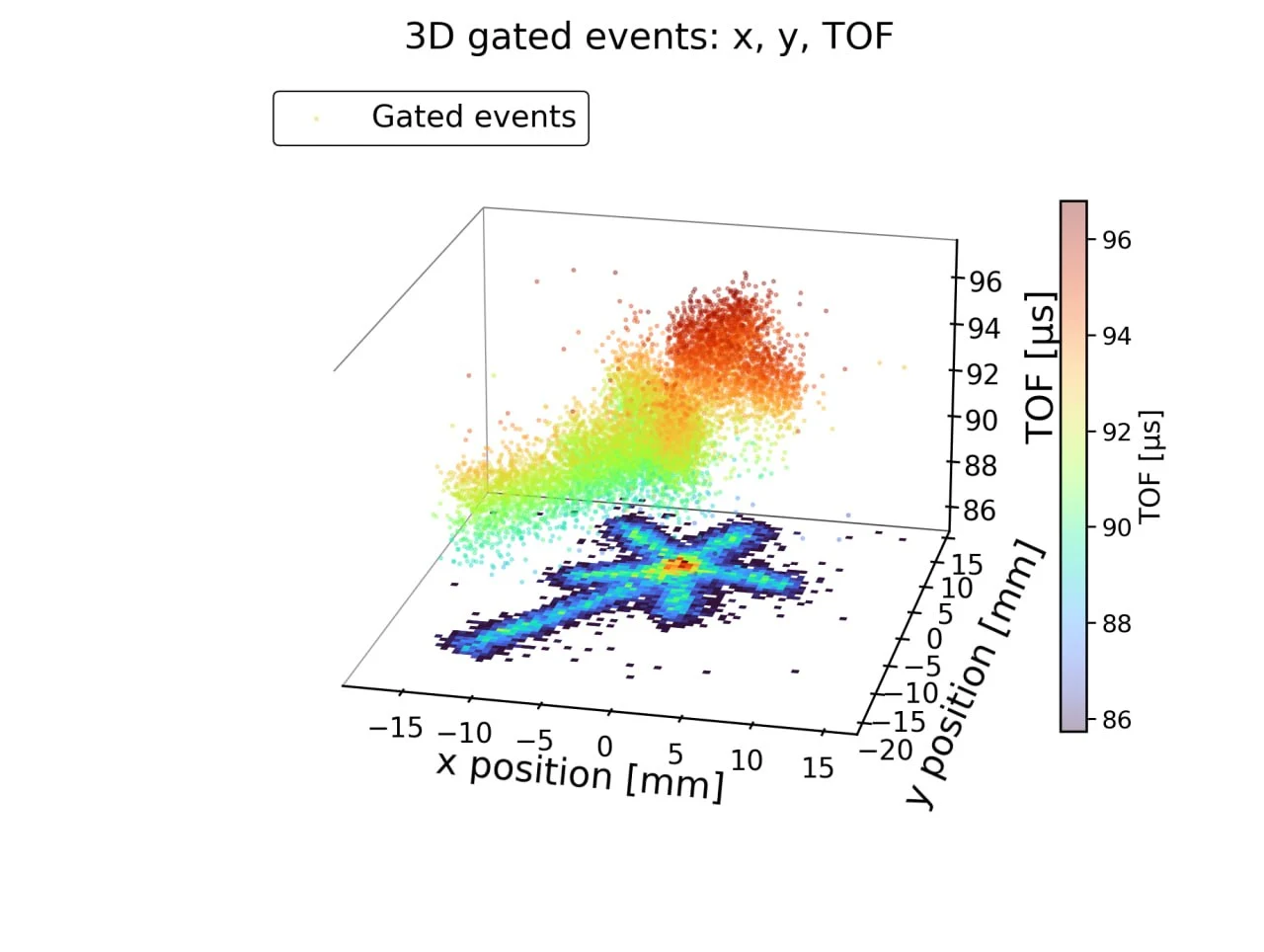
ペニングトラップ質量分析。 電荷 q・質量 m のイオンは、強い磁場 B と弱い静電四重極ポテンシャル中で3つの固有運動を行い、換算サイクロトロン周波数とマグネトロン周波数の和は非常によい近似で自由サイクロトロン周波数 νc = qB/(2πm) に等しくなります。測定対象イオンと質量既知の参照イオンの νc を比べると磁場が相殺され、質量は周波数比から求まります。JYFLTRAP では第1のトラップがバッファーガス冷却でイオンバンチを精製し、第2のトラップで測定します。短寿命核でも 10−8 以下の相対不確かさに達します。飛行時間イオンサイクロトロン共鳴(TOF-ICR)法では励起周波数を掃引し、共鳴は検出器までの飛行時間の極小として現れます。位相イメージング(PI-ICR)法では一定時間に蓄積した動径方向の位相を位置敏感検出器に投影し、分解能が高く、低い励起エネルギーのアイソマーも分離できます。
多重反射型飛行時間(MR-TOF)質量分析。 イオンは2つの静電ミラーの間で何度も反射され、コンパクトな装置で飛行距離が数百メートルに延びます。質量分解能 R = m/Δm = t/(2Δt) は飛行時間とともに増すため、同重体はミリ秒以内に分離でき、装置は同重体分離器・質量分析器・ビーム診断として使えます。m/q は (t − t0)2 に比例するので、参照イオンで較正します。
崩壊エネルギーとニュートリノ質量。 β⁻ 崩壊や電子捕獲の Q 値は親核と娘核の原子質量の差 Q = [M(親) − M(娘)]c2 です。ニュートリノ質量の直接測定実験はスペクトルの終端付近を解析し、非常に小さい Q は感度を高めます。keV 未満の精度のペニングトラップ Q 値測定は、そのような超低 Q 遷移を見いだし、不適格な候補を除外します。
原子核の構造。 質量から得られる結合エネルギーは、殻閉鎖(魔法数の後での2中性子分離エネルギーの低下)、対相関(奇偶スタッガリング)、N = Z 核の余分な結合を示し、鏡映核はクーロン変位エネルギーを通じてアイソスピン対称性を検証します。¹⁰⁰Sn は二重閉殻が期待される最も重い自己共役核です。
原子核宇宙物理。 X線バーストやνp過程では反応の流れが陽子ドリップ線の近くを進み、陽子捕獲の Q 値が小さい原子核で待機します。r過程では中性子分離エネルギーが中性子捕獲の経路を決めます。したがって質量は元素の起源を考える上で中心的な核物理入力です。パネル 周期表と元素の起源 も参照してください。
同位体シフト。 同位体列のレーザー分光では質量シフトに正確な原子質量が必要で、測定シフトから抽出する電荷半径差の不確かさを減らします。