8. What is light? From rays to Maxwell
From amplitudes to intensity #
A wave amplitude can have positive, negative or complex phase. Intensity is proportional to the squared amplitude. Coherent amplitudes add before squaring; independent intensities add after averaging. Angles in Snell’s law are measured from the surface normal. The source-free vacuum equations below assume no charges and no currents.
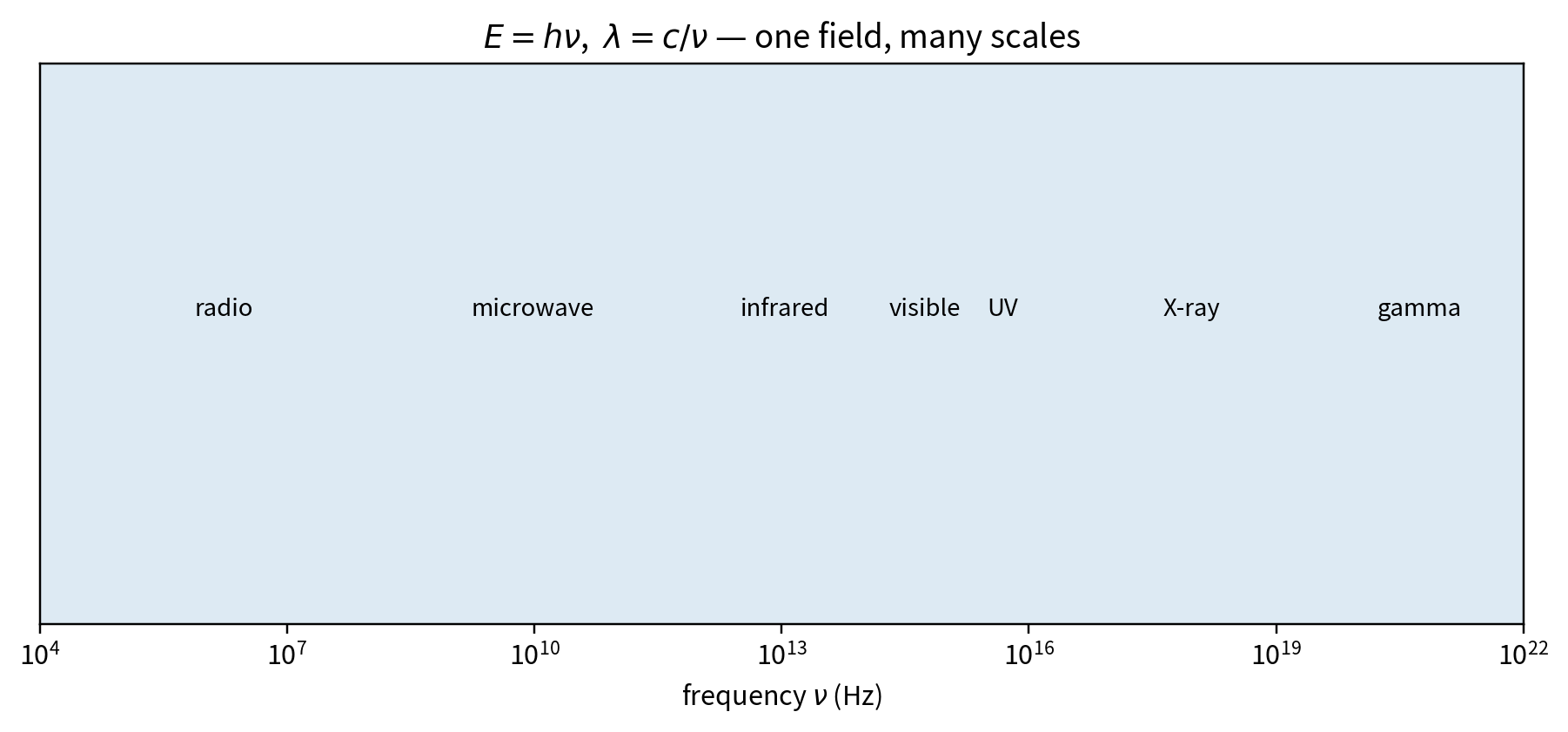
8.1 Level 1: geometric optics #
When wavelengths are much smaller than apertures and obstacles, light is efficiently described by rays. Reflection obeys
and Snell’s law is
Geometric optics is an approximation to wave propagation, not evidence that light is made of rigid microscopic pellets.
8.2 Level 2: interference and diffraction #
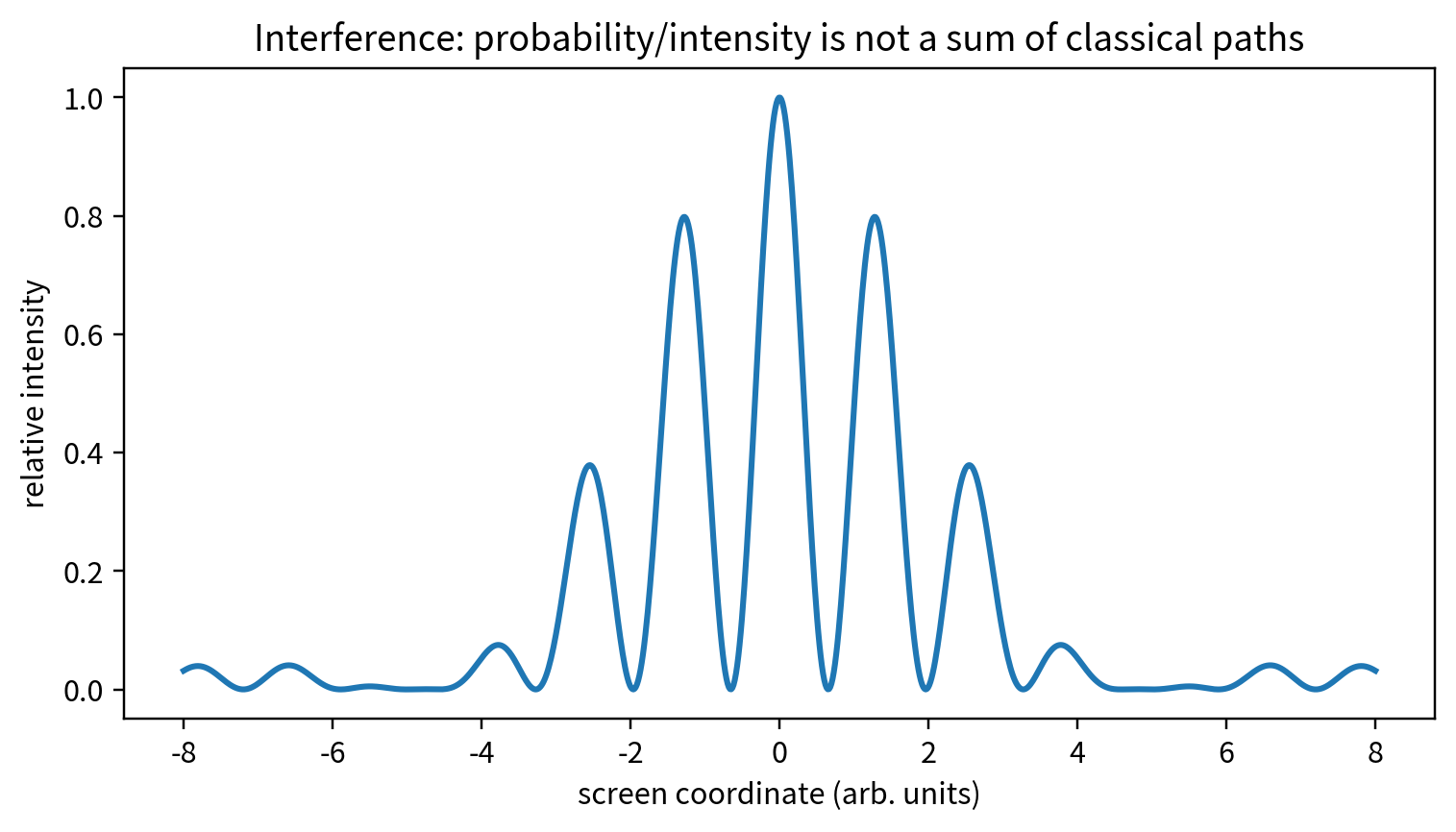
Young’s interference experiments established the power of a wave description. For two coherent paths with phase difference , equal-amplitude fields produce
This cross term distinguishes coherent wave amplitudes from a simple classical addition of intensities. The Bakerian Lecture: On the theory of light and colours (1802)
Polarization further shows that electromagnetic radiation has transverse degrees of freedom. Classical wave optics correctly predicts a vast domain of diffraction, interference, imaging, Fourier optics, and polarization phenomena.
8.3 Level 3: Maxwell’s electromagnetic wave #
In vacuum, Maxwell’s equations are
Taking another curl yields the wave equation
and similarly for , with wave speed
Maxwell recognized that the calculated electromagnetic wave speed agreed with the measured speed of light, leading to the electromagnetic theory of light. A Dynamical Theory of the Electromagnetic Field (1865)
In modern SI, the speed of light is defined exactly as
The Planck constant and elementary charge are also exact SI defining constants:
CODATA recommended values of the fundamental physical constants: 2022 (2024)
8.4 Ether and Michelson-Morley #
Nineteenth-century physicists often assumed that a mechanical wave required a medium, so an electromagnetic “luminiferous ether” was proposed. The Michelson-Morley experiment found no expected leading second-order directional ether-wind signal within its sensitivity and became one of the historically important constraints on ether models. On the Relative Motion of the Earth and the Luminiferous Ether (1887)
It is an oversimplification to say that one experiment single-handedly “proved the ether does not exist.” The deeper replacement came from a new spacetime kinematics: special relativity and Lorentz invariance.