Tutkimus
Topic guide — what do these subjects study?
These browsing tags overlap: a paper can belong to several topics. Counts show this bibliography, not the number of papers in the whole field. A topic with zero papers still has a learning explanation; it does not imply a publication here. Use the topic filter with year, author role and search. “Mass spectrometry” is the usual term for measuring masses; optical spectroscopy measures spectra. Topic explanations: English.
Existing research themes
N = Z nuclei / MASSPASS (4)
Precision masses near equal neutron and proton numbers probe shell evolution and astrophysical reaction paths.
Typical observables: See the linked research programme and papers.
Show papers (4)Q values for neutrino physics (11)
Decay-energy measurements assess candidates for direct neutrino-mass experiments.
Typical observables: See the linked research programme and papers.
Show papers (11)Atomic masses and isotope shifts (1)
Accurate atomic masses support isotope-shift analysis and the separation of mass and nuclear-size effects.
Typical observables: See the linked research programme and papers.
Show papers (1)Storage rings, MR-TOF and MCP detectors (7)
Ion manipulation, precision timing and position detection enable rare-isotope mass measurements.
Typical observables: See the linked research programme and papers.
Show papers (7)Mass methods and beams
Mass spectrometry and ion-beam applications (71)
Measures and separates ions by mass-to-charge ratio. Precision masses and clean isotope beams support decay-energy, nuclear-structure and astrophysics studies.
Typical observables: Atomic masses, Q values, beam purity and emittance.
Show papers (71)Mass-spectrometry innovations in heavy-ion research (27)
Develops Penning traps, MR-TOF instruments, storage rings, timing detectors and ion optics for rare isotopes. Read resolving power, accuracy and efficiency separately: a narrow peak alone does not establish an accurate mass.
Typical observables: Resolving power, calibration, timing, transmission and systematic uncertainty.
Show papers (27)Laser spectroscopy and ion sources (4)
Laser spectroscopy uses isotope shifts and hyperfine structure to determine radii, spins and moments. Ion sources create and prepare the required beam; a laser-ablation source is not automatically a laser-spectroscopy measurement.
Typical observables: Isotope shifts, hyperfine constants, charge radii, beam yield and purity.
Show papers (4)Nuclear structure
Shape coexistence and nuclear structure (0)
Different intrinsic nuclear shapes can produce low-lying states in the same nucleus. Energies, electromagnetic transitions and radii help distinguish coexistence from a gradual change in deformation; a mass trend alone is not proof.
Typical observables: Low-lying 0+ states, E0/E2 strengths, charge radii and configuration mixing.
Show papers (0)Nuclear structure and isotope evolution (25)
Follows how shell structure, pairing and deformation change along isotope or isotone chains. Here isotope evolution means changes with proton or neutron number, rather than motion of isotopes through a material.
Typical observables: Separation energies, shell gaps, pairing indicators, radii and isomers.
FRIB nuclear theory · IGISOL research programme ·
Show papers (25)Multi-neutron systems (4)
Investigates correlations and possible resonances in systems made only of neutrons. A short-lived resonance-like structure must be distinguished from a bound nucleus and from final-state interaction effects.
Typical observables: Missing-mass spectra, relative energies, widths and reaction-model dependence.
Observation of a correlated free four-neutron system ·
Show papers (4)Dipole resonances and strength distributions (1)
Examines dipole excitations and how their strength is distributed in energy. Electric dipole motion can reveal collective response and weakly bound neutron dynamics; a low-energy peak requires interpretation before being called a distinct resonance.
Typical observables: E1 strength, excitation energy, decay channels and polarizability.
Show papers (1)Octupole deformation and correlations (1)
Reflection-asymmetric, often pear-like shapes involve octupole degrees of freedom. Static deformation and octupole vibrations are different possibilities, tested through spectra, parity partners and electric-octupole transition strengths.
Typical observables: Parity doublets, E3 strengths, collective bands and deformation indicators.
Octupole collective motion review ·
Show papers (1)Nuclear structure and isospin symmetry (3)
Compares mirror nuclei and isobaric multiplets by exchanging proton and neutron roles. Coulomb effects and other charge-dependent interactions break ideal isospin symmetry, affecting displacement energies and precision weak-decay tests.
Typical observables: Multiplet masses, Coulomb displacement energies, IMME coefficients and decay corrections.
FRIB fundamental symmetries · FRIB nuclear theory ·
Show papers (3)Neutron skins and nuclear symmetry energy (0)
The neutron skin is the difference between neutron and proton root-mean-square radii. Its relation to the density dependence of symmetry energy is model-dependent; charge radii alone do not directly measure a neutron skin.
Typical observables: Neutron/proton radii, parity-violating scattering, dipole polarizability and equation-of-state constraints.
Show papers (0)Decay and symmetries
Beta decay and fundamental symmetries (2)
Uses decay rates, spectra and angular correlations to test the weak interaction. Searches for time-reversal violation or non-standard couplings need controlled nuclear and detector effects; an ordinary beta-decay measurement is not itself evidence of symmetry violation.
Typical observables: Correlation coefficients, Vud, spectral shapes and systematic corrections.
Show papers (2)Neutrino masses and double beta decay (13)
Direct beta or electron-capture endpoints probe the neutrino mass scale through decay kinematics. Double-beta studies also need Q values and nuclear matrix elements; neutrinoless decay, if observed, would test lepton-number conservation. These methods make different assumptions.
Typical observables: Q values, endpoint spectra, phase-space factors, matrix elements and backgrounds.
DOE: neutrinoless double beta decay ·
Show papers (13)Nuclear structure and isotope decay (29)
Uses radioactive decay to identify levels, spins, transition strengths and long-lived isomers. Decay energies and branching ratios connect the mass surface to the structure of parent and daughter nuclei.
Typical observables: Half-lives, Q values, branching ratios, level schemes and beta strength.
IGISOL research programme · FRIB fundamental symmetries ·
Show papers (29)Nuclear astrophysics
Nucleosynthesis and the chemical evolution of stars (7)
Links nuclear reaction and decay networks to the abundance of elements in stars and ejecta. Masses and lifetimes constrain pathways, while stellar evolution and mixing determine how products reach later generations of stars.
Typical observables: Abundances, reaction flows, masses, half-lives and astrophysical conditions.
Show papers (7)Nuclear reactions and nucleosynthesis in novae (0)
Classical novae are thermonuclear outbursts on accreting white dwarfs. Resonances, proton captures and beta decays determine reaction rates and the isotopes ejected; a supernova or Big-Bang study is not automatically a nova study.
Typical observables: Resonance energies and strengths, temperature-dependent rates and ejecta yields.
JINA: nuclear astrophysics · IGISOL research programme ·
Show papers (0)Astrophysical reactions and nuclear dynamics (8)
Connects laboratory cross sections and resonances with reaction rates in astrophysical plasmas. Reaction mechanisms, target states and uncertainties matter when translating a beam experiment into a stellar rate.
Typical observables: Cross sections, resonance strengths, reaction rates and network sensitivity.
Show papers (8)Heavy nuclei and reactions
Superheavy-element synthesis and decay (0)
Creates the heaviest nuclei in fusion reactions and identifies them through decay chains. Production probabilities compete with fission, and shell effects influence survival. Transfer reactions on heavy targets do not automatically imply superheavy-element synthesis.
Typical observables: Evaporation-residue cross sections, alpha-decay chains and fission lifetimes.
GSI superheavy-nucleus research ·
Show papers (0)Fission-fragment dynamics and energy distributions (2)
Studies how a fissioning nucleus divides mass, charge, energy and angular momentum between fragments. Fragment yields and isomer populations constrain the roles of shell structure, excitation and the scission process.
Typical observables: Mass/charge yields, total kinetic energy, spin distributions and isomeric ratios.
GSI: shell effects in fission ·
Show papers (2)Detector technologies
Superconducting calorimeters for precision detection (0)
Measures deposited energy as a tiny temperature rise at cryogenic temperatures. Transition-edge sensors use the steep resistance change near a superconducting transition; energy resolution, response time and background must be assessed together.
Typical observables: Energy resolution, thermal response, pile-up, calibration and noise.
Show papers (0)Resistive plate chambers in particle detection (0)
Gas detectors with resistive electrodes amplify ionization signals in a strong electric field. They provide fast timing and triggering in particle experiments; they are a different technology from MCP detectors.
Typical observables: Efficiency, time resolution, rate capability, gas mixture and ageing.
CMS resistive plate chambers ·
Show papers (0)Käytän tarkkaa ioniloukku- ja varastorengasmassaspektrometriaa neutriinofysiikan, ydinrakenteen ja ydinastrofysiikan kysymyksiin. Kunkin aiheen julkaisut tulevat yhteisestä julkaisutietokannasta; koko luettelo on Julkaisut -sivulla.
Menetelmät kuvina #
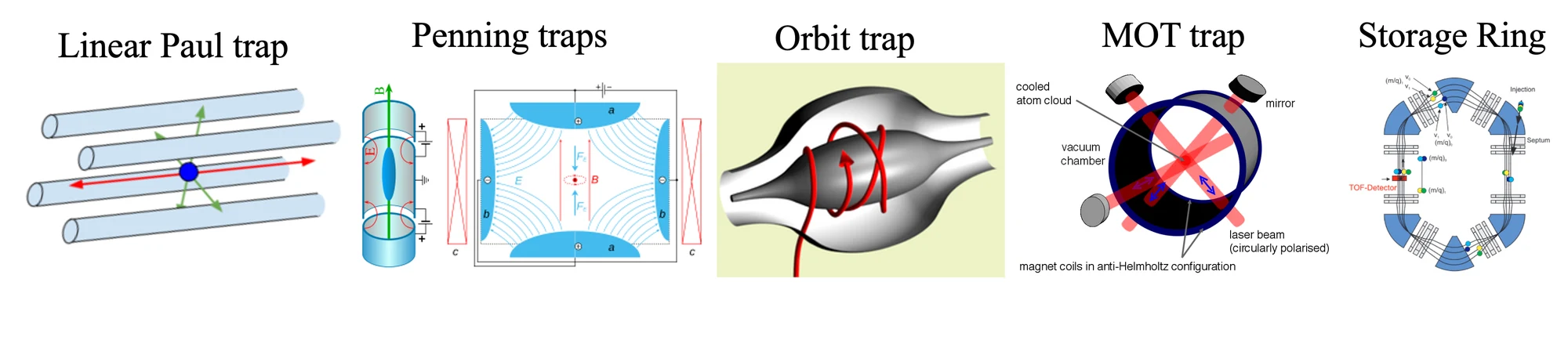

Ioni- ja atomiloukkujen perhe — miten ne toimivat
Animoituja luonnoksia, ei mittakaavassa. Punainen/sininen = elektrodien napaisuus (vaihtuu RF:n mukana); värijälki on yksi ioni tai atomi.
Eksoottiset N = Z -ytimet ¹⁰⁰Sn:ään asti — MASSPASS #
Akatemiatutkijan hanke (johtaja). Eksoottisten N = Z -ytimien ja niiden naapurien massamittaukset ¹⁰⁰Sn:ään asti IGISOLissa (Jyväskylä) ja RIKENissä (Japani): kuorirakenteen kehitys kohti raskainta itsekonjugoitua kaksoismaagista ydintä sekä rp-prosessin ydinfysikaalinen syöte. Hankkeen sivu
4 viitetietuetta
- , Direct mass measurement of ⁹¹Rh and ⁸⁹Ru and mid-shell trend of the one-proton separation energies for N = Z + 1 nuclei, Phys. Rev. C 114, 034311 (2026)
- , Direct mass measurement of ⁹³Pd and implications for the isomer structures in ⁹⁴Ag, Phys. Rev. Research 7, L042022 (2025)
- , High-precision mass measurements of neutron-deficient silver isotopes probe the robustness of the N = 50 shell closure, Phys. Rev. Lett. 133, 132503 (2024) · arXiv:2401.07976
- , Study of mass-measurement method for N = Z nuclei with isochronous mass spectrometry, Nucl. Phys. Rev. 36, 294 (2019)
Q-arvot neutriinon massan määrittämiseen #
Hajoamisenergioiden (Q-arvojen) suorat Penning-loukkumittaukset paljastavat erittäin pienen Q-arvon β⁻- ja elektronisieppaussiirtymiä tuleviin neutriinon massan mittauksiin ja sulkevat pois sopimattomat ehdokkaat.
11 viitetietuetta
- , Precise determination of electron-capture Q value of ¹¹³Sn decay related to electron neutrino mass measurements, Phys. Rev. C 114, 035501 (2026) · arXiv:2604.03410 — QEC = 1039.25(19) keV
- , High-precision direct decay energy measurements of the electron-capture decay of ⁹⁷Tc, Phys. Rev. C 112, 035501 (2025) · arXiv:2502.04490 — QEC = 324.82(21) keV
- , High-precision measurements of the atomic mass and electron-capture decay Q value of ⁹⁵Tc, Phys. Lett. B 859, 139094 (2024) · arXiv:2406.05273
- , Direct high-precision measurement of the mass difference of ⁷⁷As–⁷⁷Se related to neutrino mass determination, Eur. Phys. J. A 60, 104 (2024) · arXiv:2401.15242
- , β⁻ decay Q-value measurement of ¹³⁶Cs and its implications for neutrino studies, Phys. Rev. C 108, 045502 (2023) · arXiv:2306.04604
- , Direct determination of the atomic mass difference of the pairs ⁷⁶As–⁷⁶Se and ¹⁵⁵Tb–¹⁵⁵Gd rules out ⁷⁶As and ¹⁵⁵Tb as possible candidates for electron (anti)neutrino mass measurements, Phys. Rev. C 106, 015502 (2022) · arXiv:2202.07656
- , High-precision electron-capture Q value measurement of ¹¹¹In for electron-neutrino mass determination, Phys. Lett. B 832, 137226 (2022) · arXiv:2201.12573
- , Observation of an ultralow-Q-value electron-capture channel decaying to ⁷⁵As via a high-precision mass measurement, Phys. Rev. C 106, 015501 (2022) · arXiv:2203.00457
- , High-precision measurement of a low Q value for allowed β⁻ decay of ¹³¹I related to neutrino mass determination, Phys. Lett. B 830, 137135 (2022)
- , ¹⁵⁹Dy electron-capture: a new candidate for neutrino mass determination, Phys. Rev. Lett. 127, 272301 (2021) · arXiv:2106.06626
- , Direct measurement of the mass difference of ⁷²As–⁷²Ge rules out ⁷²As as a promising β-decay candidate to determine the neutrino mass, Phys. Rev. C 103, 065502 (2021) · arXiv:2103.08729
Atomimassat isotooppisiirtymätutkimuksiin #
1 viitetietuetta
- , High-precision measurement of the atomic mass of ⁸⁴Sr and implications to isotope shift studies, Eur. Phys. J. A 60, 147 (2024) · arXiv:2404.02025
Varastorenkaat, MR-TOF ja MCP-ilmaisimet #
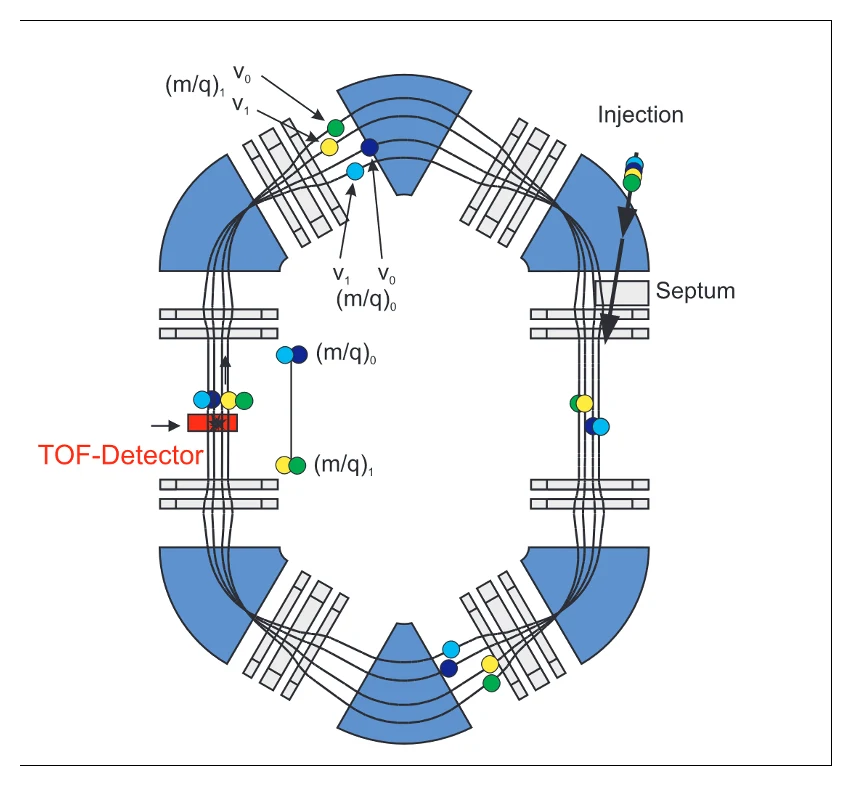
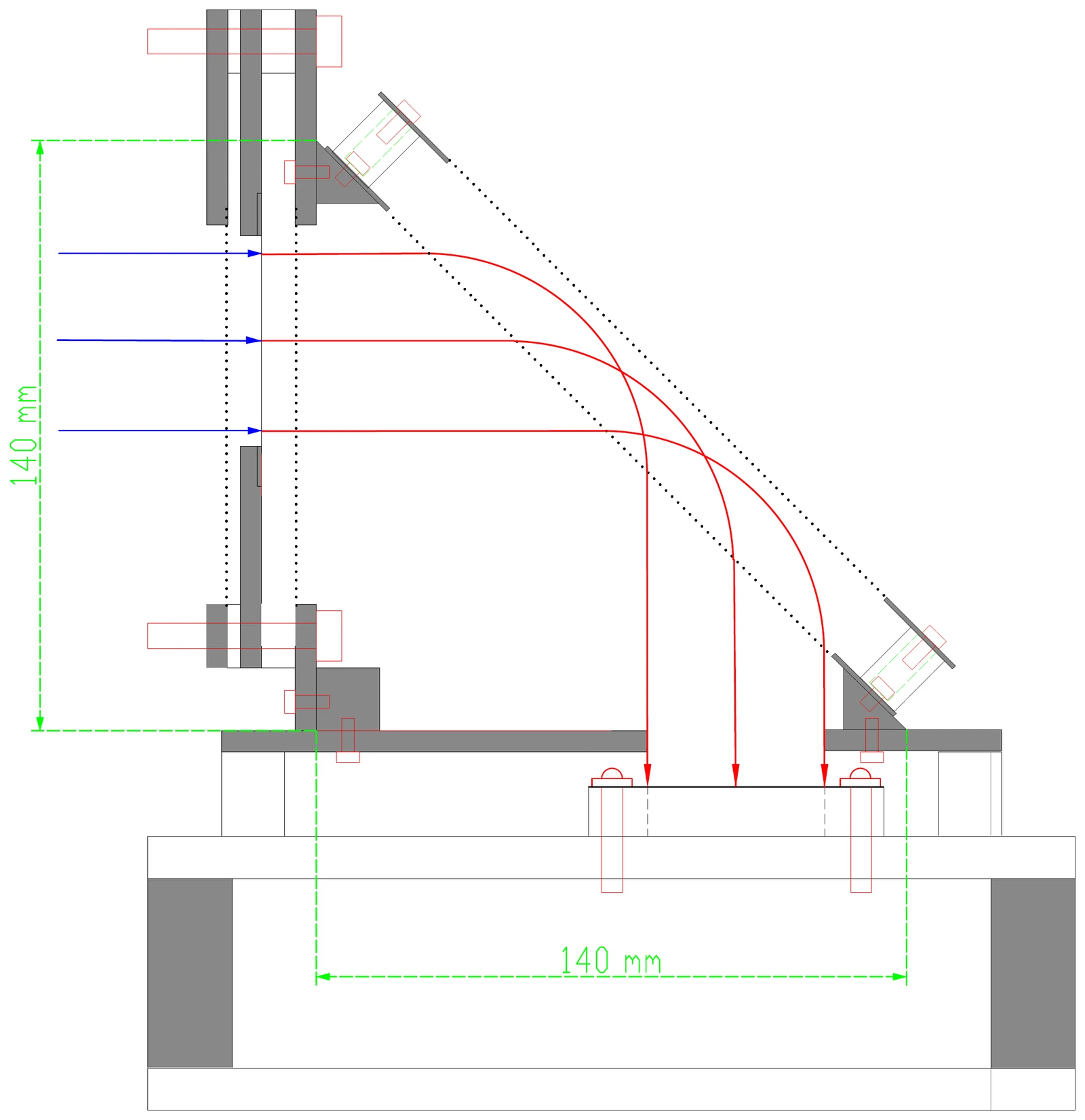
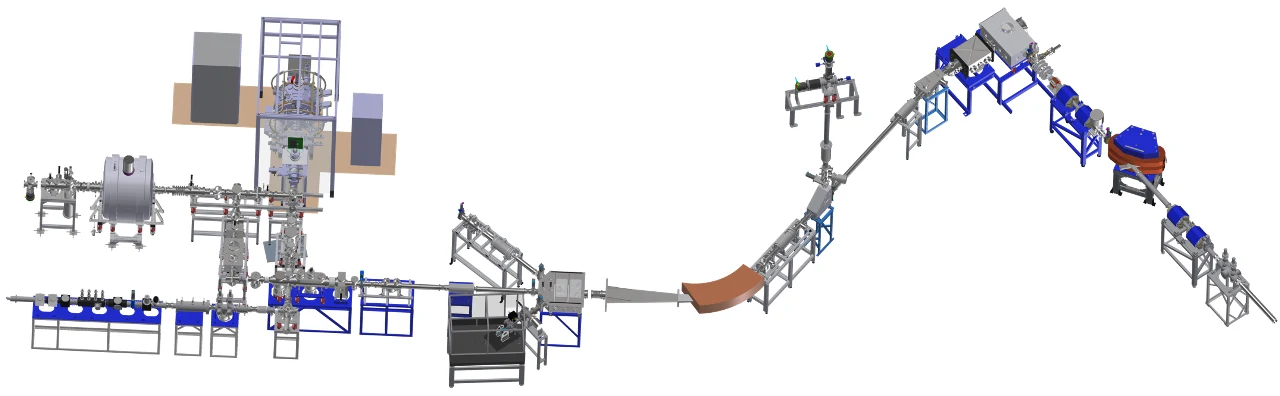
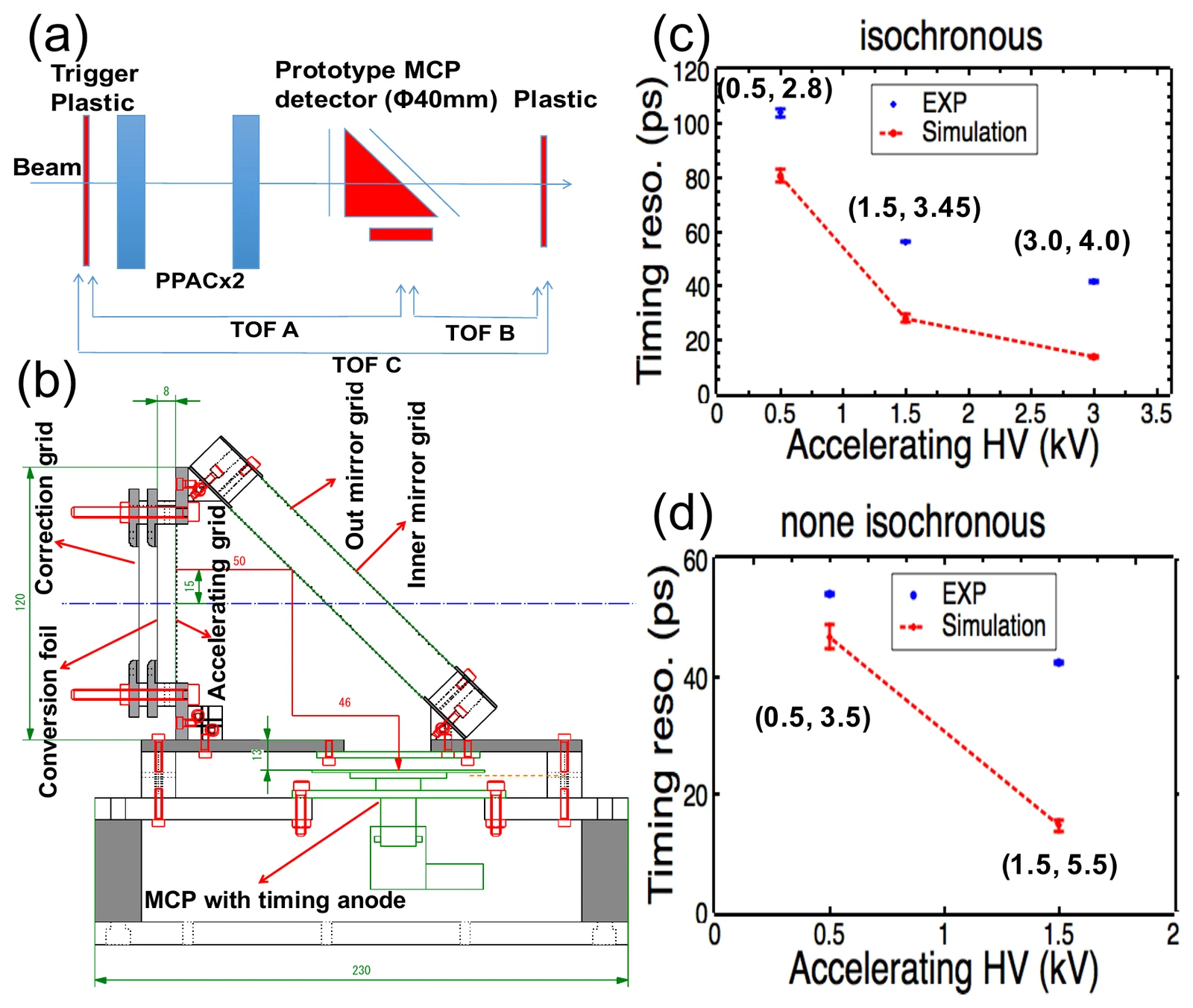
Väitöstyö RIKENin Rare-RI Ringillä: sekundääri-ionien tunnistus isokronisiin massamittauksiin sekä ajoitus- ja paikkaherkät mikrokanavalevyilmaisimet (MCP). Myöhemmin MR-TOF-spektrometrit IGISOLissa ja GSI:n FRS Ion Catcherilla sekä HIAF-ilmaisinkonseptit.
7 viitetietuetta
- , High-resolution multi-reflection time-of-flight mass spectrometer for exotic nuclei at IGISOL, Nucl. Instrum. Methods A 1088, 171513 (2026)
- , Overview of high-performance timing and position-sensitive MCP detectors utilizing secondary electron emission for mass measurements of exotic nuclei at nuclear physics facilities, Sensors 24, 7261 (2024) — review
- , Development of a large-area timing and position-sensitive foil-MCP detector for mass measurements at the Rare-RI Ring in RIKEN, arXiv preprint (2021) · arXiv:2106.08264
- , Development of mirror-type MCP detectors for mass measurements at the Rare-RI Ring, JPS Conf. Proc. 35, 011023 (2021)
- , Scheme of high-resolution identification and selection of secondary ions for mass measurements with the Rare-RI Ring, Hyperfine Interact. 240, 92 (2019)
- , Electrostatic-lenses position-sensitive TOF MCP detector for beam diagnostics and new scheme for mass measurements at HIAF, Nucl. Sci. Tech. 30, 152 (2019) · arXiv:2105.14551
- , Timing performance of a mirror-type MCP detector for mass measurements at the Rare RI Ring, RIKEN Accel. Prog. Rep. 51, 152 (2018)
Ionioptiikan suunnittelu #
Suihkulinjojen, varastorenkaiden ja loukkulaitteistojen ionioptinen suunnittelu: RIKENin Rare-RI Ringin injektio-ionioptiikka, isokronisten massamittausten simulaatiot sekä nykyisin RFQ-, MR-TOF- ja Penning-loukkulinjojen suunnittelu SIMIONilla.
- Z. Ge, Q. Wang, M. Wang, T. Uesaka, Study of mass-measurement method for N = Z nuclei with isochronous mass spectrometry, Nucl. Phys. Rev. 36, 294 (2019)
- Z. Ge et al., Online results for the injection ion optics of the Rare RI Ring, RIKEN Accel. Prog. Rep. 49, 180 (2016)
Ydinfysiikka #
- Kuorirakenteen kehitys ja maagiset luvut kaukana stabiilisuudesta — N = Z -ytimet kohti ¹⁰⁰Sn:ää
- Isospinsymmetria, peiliytimet ja Coulombin siirtymäenergiat
- Separaatioenergiat, parittuminen ja isomeerit tarkoista massoista
- Harvinaisten hajoamisten Q-arvot neutriinofysiikkaan
Ydinastrofysiikka #
- Massat rp- ja νp-prosessien odotuspisteissä lähellä N = Z
- Neutronirikkaiden ytimien massat r-prosessin verkkolaskuihin
- Ydinfysiikan syötteet röntgenpurkauksiin ja alkuaineiden syntyyn
Tieteellinen tausta #
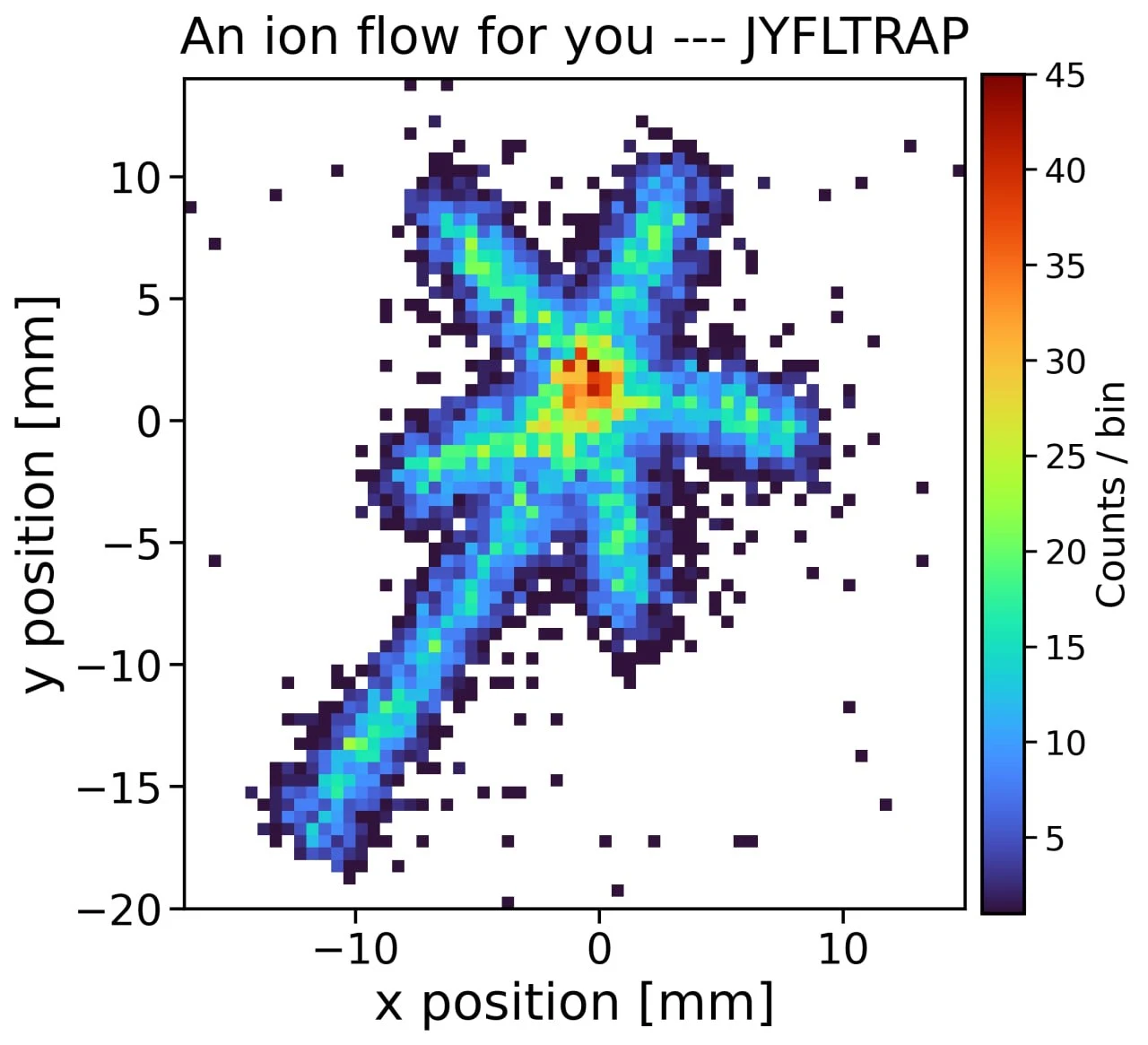
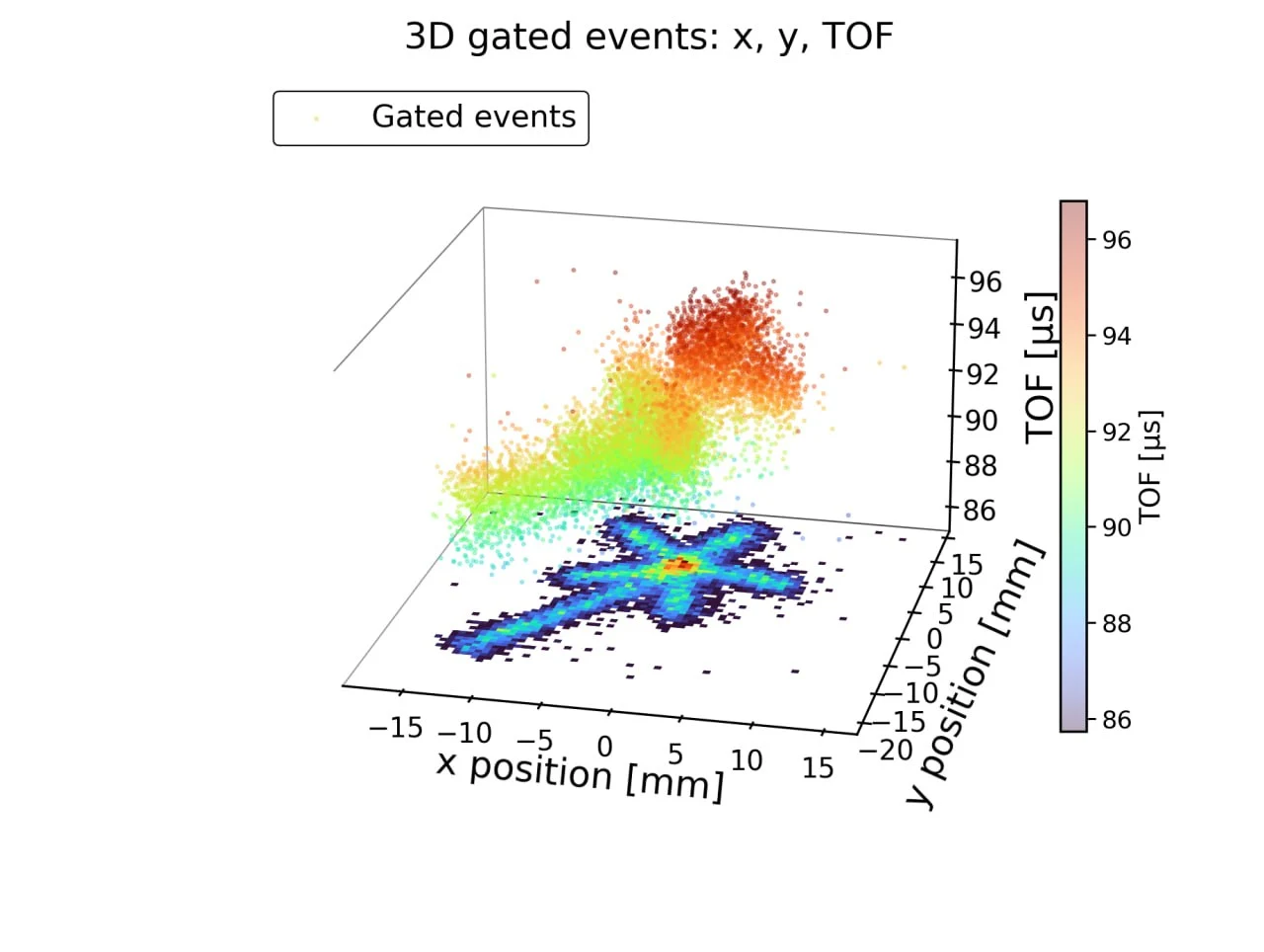
Penning-loukkumassaspektrometria. Varauksen q ja massan m ioni voimakkaassa magneettikentässä B ja heikossa sähköstaattisessa kvadrupolipotentiaalissa suorittaa kolme ominaisliikettä; redusoidun syklotroni- ja magnetronitaajuuden summa on erittäin hyvällä approksimaatiolla vapaa syklotronitaajuus νc = qB/(2πm). Kun kiinnostavan ionin νc verrataan hyvin tunnetun referenssi-ionin taajuuteen, magneettikenttä supistuu pois ja massa saadaan taajuussuhteesta. JYFLTRAPissa ensimmäinen loukku puhdistaa ionipaketin puskurikaasujäähdytyksellä ja toinen suorittaa mittauksen; lyhytikäisille ytimille voidaan saavuttaa 10−8 ja parempi suhteellinen epävarmuus. Lentoaikaan perustuvassa ionisyklotroniresonanssimenetelmässä (TOF-ICR) viritystaajuutta pyyhkäistään ja resonanssi näkyy lentoajan minimina ilmaisimelle; vaihekuvauksessa (PI-ICR) kiinteässä ajassa kertynyt radiaalinen vaihe heijastetaan paikkaherkälle ilmaisimelle, mikä antaa paremman erotuskyvyn ja erottaa matalat isomeeritilat.
MR-TOF-massaspektrometria. Ionit heijastuvat monta kertaa kahden sähköstaattisen peilin välillä, mikä pidentää lentomatkan satoihin metreihin kompaktissa laitteessa. Erotuskyky R = m/Δm = t/(2Δt) kasvaa lentoajan mukana, joten isobaarit erottuvat millisekunneissa; laite toimii isobaarierottimena, massaspektrometrina ja suihkudiagnostiikkana. Kalibrointi tehdään referenssi-ioneilla, koska m/q on verrannollinen suureeseen (t − t0)2.
Hajoamisenergiat ja neutriinon massa. β⁻-hajoamisen tai elektronikaappauksen Q-arvo on emo- ja tytärytimen atomimassojen erotus, Q = [M(emo) − M(tytär)]c2. Neutriinon massaa suoraan mittaavat kokeet tarkastelevat spektrin päätepisteen aluetta, jossa hyvin pieni Q parantaa herkkyyttä. Penning-loukkumittaukset alle keV:n tarkkuudella löytävät tällaiset erittäin pienen Q-arvon siirtymät ja sulkevat pois kelpaamattomat ehdokkaat.
Ydinrakenne. Massoista johdetut sidosenergiat paljastavat kuorisulkeumat (kahden neutronin erotusenergian pudotus maagisen luvun jälkeen), parittumisen (pariton–parillinen vaihtelu) ja N = Z -ytimien lisäsidoksen; peiliytimet testaavat isospinsymmetriaa Coulombin siirtymäenergioiden avulla. ¹⁰⁰Sn on raskain itseconjugaattinen ydin, jonka odotetaan olevan kaksoismaaginen.
Ydinastrofysiikka. Röntgenpurkauksissa ja νp-prosessissa reaktiovirta kulkee lähellä protonivuotolinjaa ja odottaa ytimissä, joilla on pieni protonikaappauksen Q-arvo; r-prosessissa neutronien erotusenergiat määrittävät neutronikaappausvirran polun. Massat ovat siksi keskeinen ydinfysikaalinen lähtötieto alkuaineiden alkuperälle; katso paneeli Jaksollinen järjestelmä ja alkuaineiden alkuperä .
Isotooppisiirtymät. Isotooppiketjujen laserspektroskopiassa massasiirtymä vaatii tarkat atomimassat; ne pienentävät mitatuista siirtymistä johdettujen varaussäteiden erotusten epävarmuutta.