2. The Standard Model map
Read the particle map #
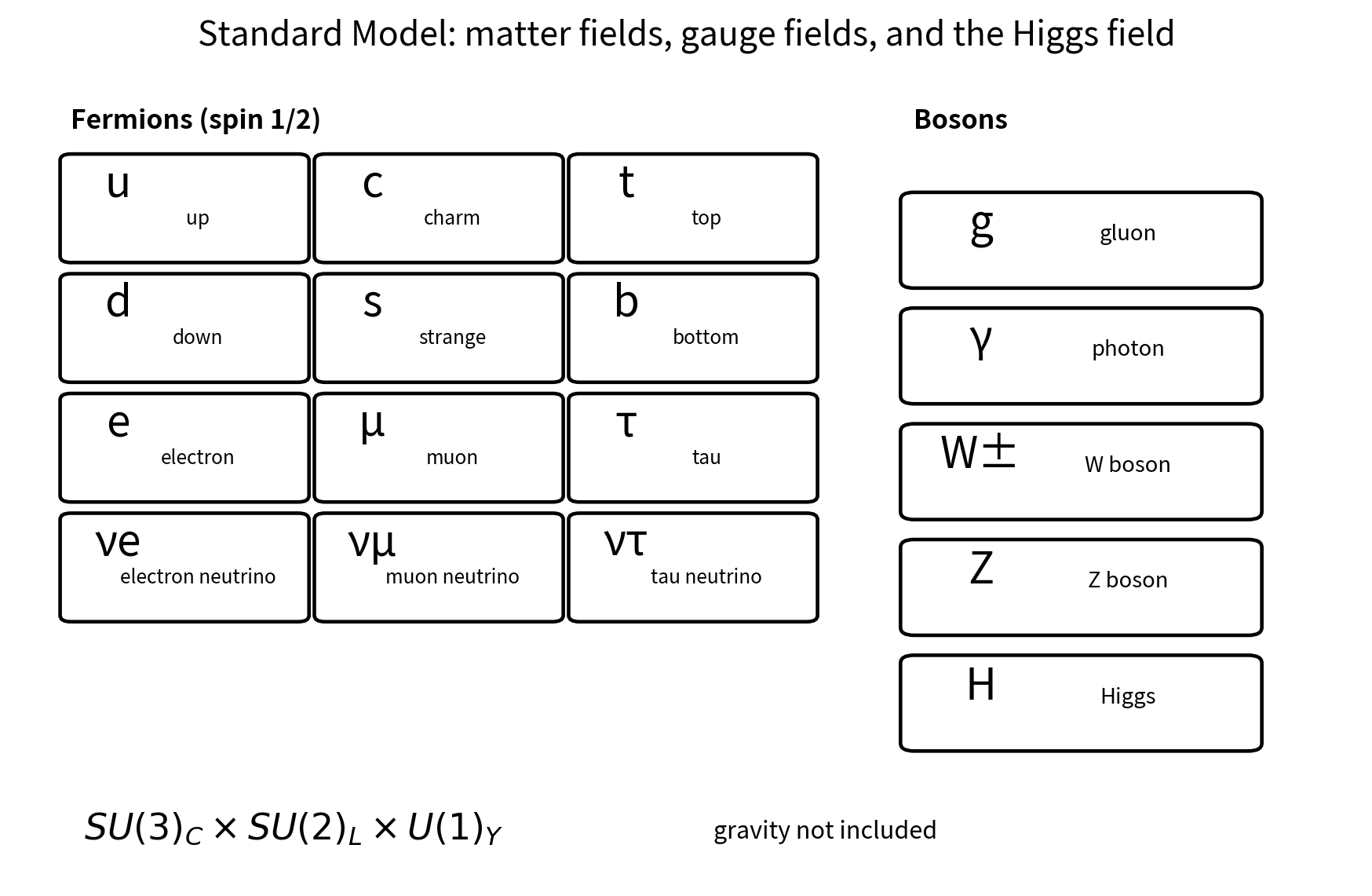
A flavour names a kind of quark or lepton, not an everyday taste. Spin is intrinsic angular momentum, not a tiny sphere rotating. Electric charge, colour charge and weak quantum numbers tell us how a field interacts. A neutrino flavour labels its weak production/detection channel; it is not a separate fourth generation.
2.1 What the Standard Model contains #
The Standard Model gauge group is
The factor is QCD; is the electroweak gauge symmetry before electroweak symmetry breaking. After the Higgs field acquires a nonzero vacuum expectation value, the residual unbroken gauge symmetry is . Conservation of Isotopic Spin and Isotopic Gauge Invariance (1954) · Partial-symmetries of weak interactions (1961) · A Model of Leptons (1967) · Electroweak Model and Constraints on New Physics (2025)
A common classroom chart displays 17 entries: six quark flavors, six leptons, four gauge-boson categories (), and the Higgs boson. That “17” is a charting convention, not a unique count of all independent quantum states. Quarks carry three colors, gluons form an octet, charged particles have antiparticles, and are distinct charge states, and neutrino counting depends on what is meant by flavor, mass eigenstate, particle, and antiparticle. It is therefore better to speak of Standard Model fields and particle species than to claim that nature contains exactly “61 fundamental particles.” 2026 Summary Tables and Particle Properties (2026)
2.2 Fermions and bosons #
Particles with half-integer spin obey Fermi-Dirac statistics; particles with integer spin obey Bose-Einstein statistics. The observed quarks and leptons are spin- fermions. Gauge bosons are spin-1, while the Higgs boson is spin-0. The spin-statistics theorem connects spin with exchange statistics in relativistic quantum field theory.
The Pauli exclusion principle follows from the antisymmetric many-fermion state: identical fermions cannot occupy the same complete one-particle quantum state. This property is essential to atomic shells, chemistry, electron degeneracy pressure, and much of the structure of ordinary matter.
Not every boson is a force carrier. The Higgs is a boson but is not the gauge mediator of one of the Standard Model interactions. Likewise, a hypothetical spin-2 graviton would belong to a quantum theory of gravity, not to the Standard Model. No graviton has been observed, and gravity is not included in the Standard Model gauge theory. Review of Particle Physics (2026)
2.3 Three generations do not mean three discovery dates #
The fermions occur in three repeated generations:
“Generation” is a structural classification, not a chronological label. The generations have the same gauge-charge pattern but very different masses and mix through the CKM matrix in the quark sector and the PMNS matrix in the neutrino sector. Why Yukawa couplings and mixing parameters have the values they do is one of the major flavor puzzles left unexplained by the Standard Model. Review of Particle Physics (2026)
2.4 Representative mass scales #
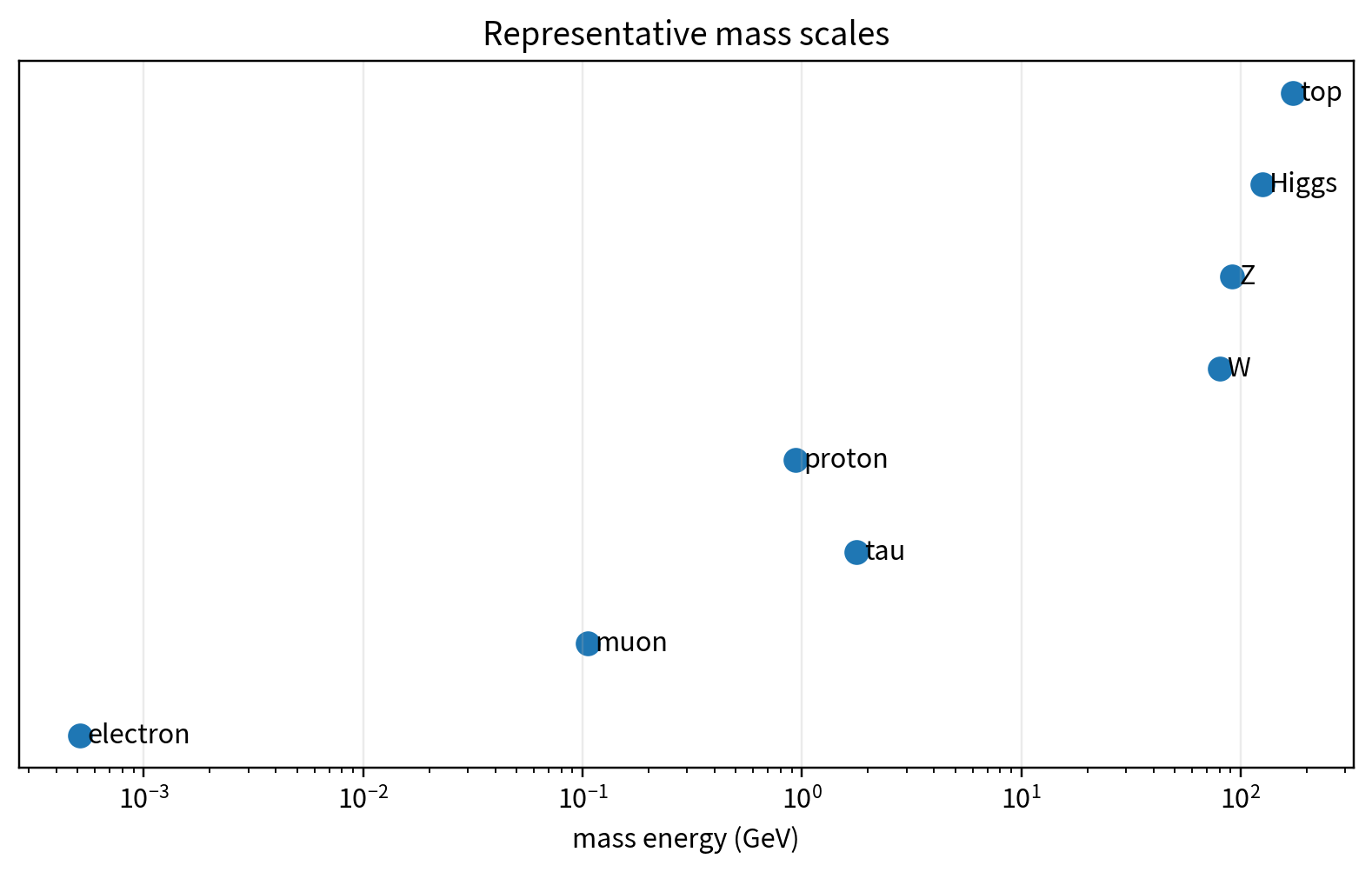
Useful benchmark values are
- and from CODATA. CODATA recommended values of the fundamental physical constants: 2022 (2024)
- and . CODATA recommended values of the fundamental physical constants: 2022 (2024)
- and as illustrative benchmark scales. Review of Particle Physics (2026) · Electroweak Model and Constraints on New Physics (2025)
- A current PDG electroweak/Higgs combination gives a Higgs mass near . Higgs Boson Physics, Status of (2025)
- The top quark is the heaviest known elementary particle, with a mass near depending on the extraction and mass definition. Review of Particle Physics (2026)
These numbers span more than five orders of magnitude even before neutrino masses are included.