10. Light and spacetime
Whose clock and whose distance? #
Proper time is the time measured by a clock along its own timelike worldline. Coordinate time belongs to a chosen frame. The sign convention here is (+,−,−,−). A null interval has zero proper time, but no inertial observer is at rest with a photon. The Doppler formula below describes radial recession in flat spacetime; cosmological redshift uses the scale factor instead.
10.1 The invariant interval #
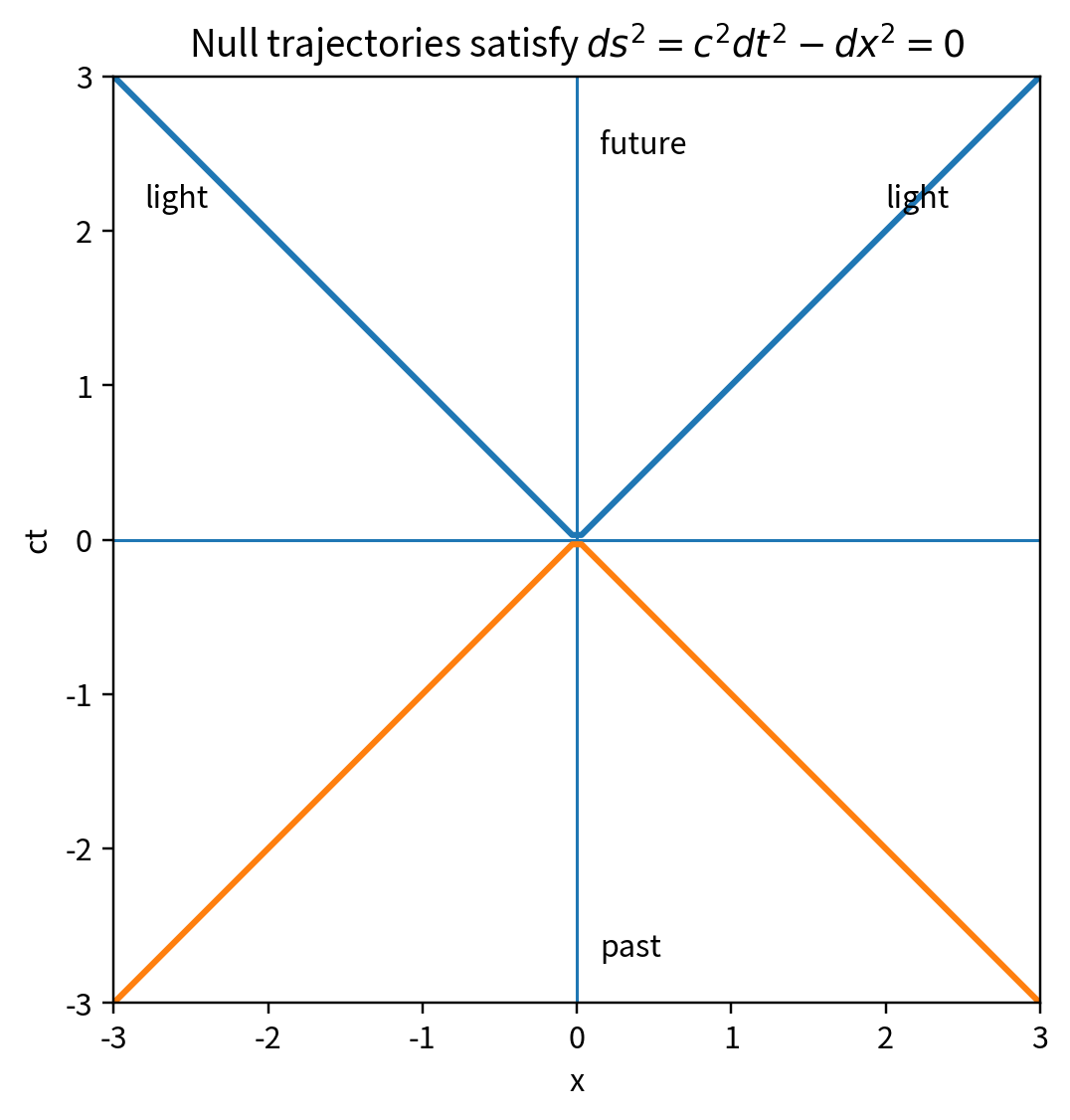
In flat spacetime,
For a massive particle following a timelike trajectory,
where is proper time. For light,
Thus an ideal null worldline has zero proper-time interval.
10.2 Why “from the photon’s point of view” is dangerous #
The Lorentz factor
diverges as . No inertial Lorentz frame exists in which a photon is at rest. It is therefore not physically legitimate to transform into “the photon’s reference frame” and ask what the photon sees. Zur Elektrodynamik bewegter K"orper (1905)
A scientifically correct but still poetic sentence is:
Light follows null trajectories for which the spacetime proper-time interval vanishes, but relativity does not define a photon rest frame.
That is the rigorous content behind the popular phrase “light does not experience time.”
10.3 Frequency is observer dependent #
Although is invariant in vacuum, photon frequency is not. For a source moving directly away at speed , the relativistic Doppler factor is
Cosmological redshift is different in origin and is commonly written
where is the cosmological scale factor.